
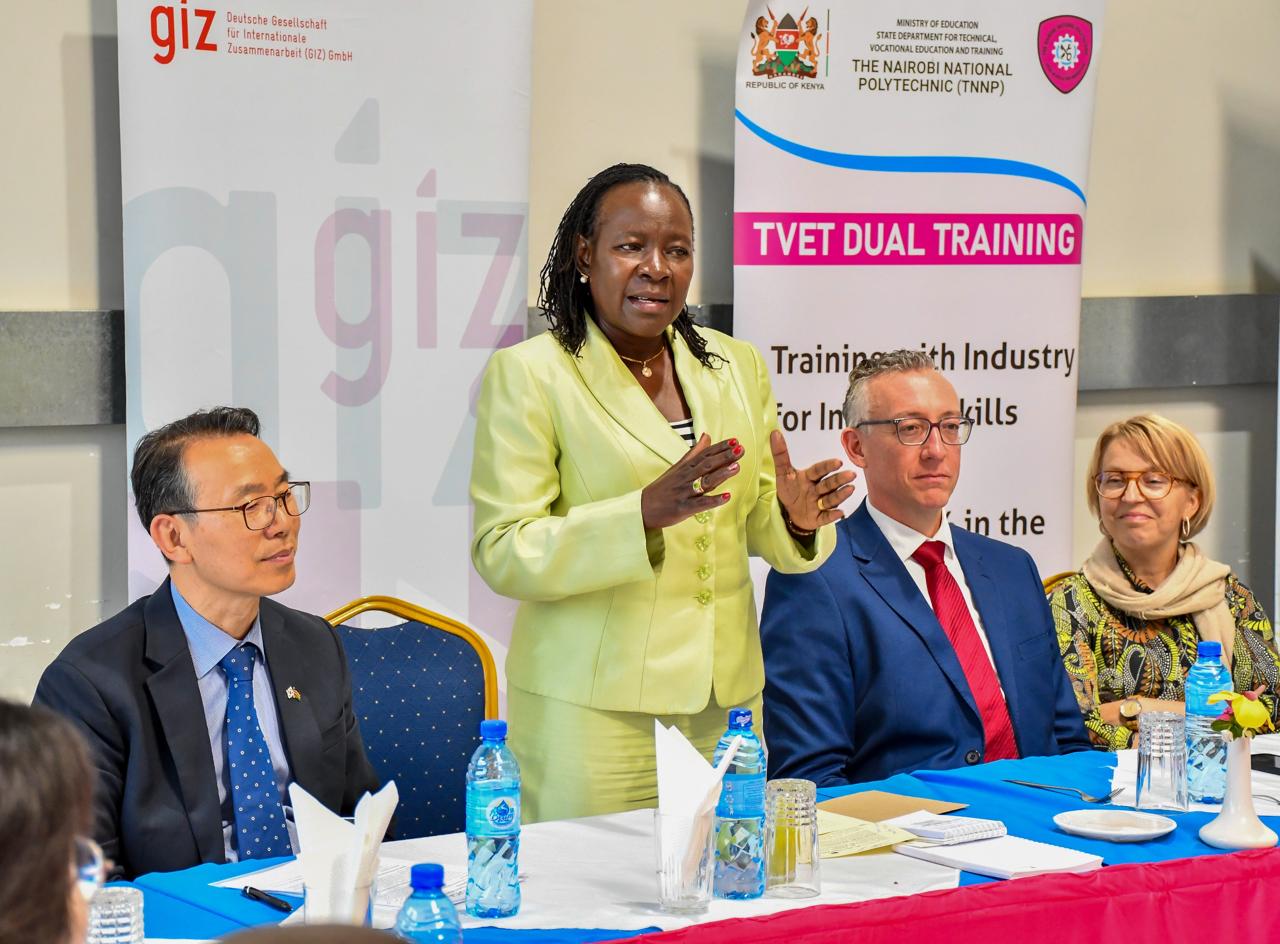
State champions industry-led TVET training to boost youth employment locally and abroad
By Joan Ogolla (PCO)
The Government is strengthening Technical and Vocational Education and Training (TVET) through expanded partnerships with industry and development partners to ensure training remains responsive to labour market needs and produces competent, industry-ready graduates.
Principal Secretary for the State Department for TVET, Dr Esther Muoria, said the government would continue deepening collaboration between training institutions and employers to equip trainees with practical skills that match industry demands.
Speaking during a project visit to the Nairobi National Polytechnic, Dr Muoria said demonstrations in the institution’s Automotive Mechatronics workshop highlighted the success of the Dual TVET model in bridging the gap between classroom instruction and workplace experience.
She noted that integrating structured workplace learning into technical training was enabling young people to gain practical competencies, industry exposure and the confidence needed to transition into employment.
“The practical demonstrations in the automotive sector are a clear indication of the value of this collaboration. We have continued to see the impact of dual training on our young people, particularly in equipping them with competencies that respond directly to industry needs,” said Dr Muoria.
The PS commended development partners and industry players supporting the initiative, saying such partnerships were crucial in enhancing the quality, relevance and responsiveness of TVET programmes.
She urged institutions to sustain collaboration with employers in curriculum delivery, practical training and workplace placements to ensure graduates acquire skills required for productive engagement in the labour market.
Dr Muoria reaffirmed the government’s commitment to positioning TVET as a key driver of youth empowerment, industrialisation and economic growth.
Finnish Ambassador to Kenya, Riina-Riikka Heikka, said the partnership demonstrated the transformative value of investing in technical skills development, noting that Dual TVET was benefiting both trainees and employers.
She observed that quality technical training was helping young people build confidence, motivation and pride while providing a strong foundation for their professional careers through a blend of classroom learning and workplace experience.
Heikka said Kenya’s youthful population represented a significant opportunity for economic growth and called for sustained investment in TVET and industry partnerships to translate skills development into tangible employment outcomes.
Ambassador of the Republic of Korea to Kenya, Kang Hyung-shik, said TVET plays a critical role in linking education and employment by combining theoretical instruction with practical industry experience.
He lauded the partnership between the Nairobi National Polytechnic and the Korea International Cooperation Agency (KOICA), particularly the establishment of the beauty training centre, and expressed satisfaction with its progress.
German Ambassador to Kenya, Sebastian Groth, praised the gains made in strengthening Kenya’s TVET sector, describing cooperation between Kenya and Germany as mutually beneficial.
He noted that technical skills development could support labour mobility and create opportunities for skilled Kenyan youth to meet labour market demands in both countries.
The visit was conducted under the Promotion of Youth Employment and Vocational Training Project, which supports the Ministry of Education in strengthening and institutionalising Dual TVET across the country.
The programme combines institution-based theoretical training with structured workplace learning through partnerships between training institutions and employers.
As of November 2026, about 100 TVET institutions had institutionalised Dual TVET programmes, involving more than 2,000 companies and approximately 20,000 trainees nationwide.
At the Nairobi National Polytechnic, more than 200 trainees in Automotive Technology, Hospitality and Information and Communication Technology have benefited from the programme since the institution began piloting Dual TVET in 2020.
The institution, which serves more than 10,000 trainees and offers over 200 courses, is also a Centre of Excellence in Automotive Mechatronics, supported by the German development bank KfW through modern training workshops and equipment.
The project is implemented through instructor training, curriculum development, modern teaching methodologies, infrastructure development and equipment support aimed at strengthening practical skills training.
Ends